Self-Paced Dutch Courses · A0 to A2
Dutch Courses Online: Learn Dutch Step by Step, In Plain English
Two self-paced Dutch courses, A1 and A2, that take you from zero to real conversations — every rule explained in plain English, not Dutch grammar jargon. Not sure which one fits you? This page walks through what's in each, who they're for, and how to pick.
What Dutch Courses Are Available?
DutchLessonsOnline offers two self-paced online Dutch courses, both written in plain English: Dutch A1, for absolute beginners, and Dutch A2, the complete course from zero all the way to A2 level. A2 already includes everything covered in A1, so you only ever need one, never both.
| Dutch A1 | Dutch A2 | |
|---|---|---|
| Level range | Zero (A0) → A1 | Zero (A0) → A2 |
| Chapters | 25 | 43 (includes all of A1) |
| Best for | Absolute beginners, simple daily situations | Beginners who want the full path, or inburgering prep |
| Format | Self-paced PDF e-book | Self-paced PDF e-book |
| Access | Lifetime, one payment | Lifetime, one payment |
| Price | €9.99 | €14.99 |
| See Dutch A1 → | See Dutch A2 → |
Can You Really Learn Dutch Online?
Yes — both courses are built entirely for self-study, with no classroom or live teacher required. Each chapter follows the same shape: a short explanation in plain English, real Dutch examples, and, in most chapters, linked online practice exercises, so nothing sits as theory for long. Read it as a PDF, on your own schedule, and come back to any chapter whenever you need a refresher.
Wondering what the download itself looks like? See what is inside the PDF course, including how it is structured and whether you can print it.
Here's What a Real Course Chapter Looks Like
Every chapter follows the same shape: a short explanation in English, real Dutch examples, and, in most chapters, linked online practice exercises. Here's an actual page from the course material, on modal verbs.
You use them with another verb, the infinitive, like to eat, to go, to speak. They show things like ability, obligation, permission, desire, or a suggestion about the future.
moeten — must / to have to
willen — want / to want to
mogen — may / to be allowed to
zullen — shall / will
Ik kan Nederlands spreken. — I can speak Dutch.
Ik moet werken. — I have to work.
Wil je mee naar het strand? — Do you want to come to the beach?
In Dutch, the main verb goes to the end of the sentence when you use a modal verb: Ik moet mijn huiswerk maken — I have to do my homework.
Most chapters like this end with linked online practice exercises, so nothing sits as theory for long.
See the real pages
These are real pages from the course PDF, not mock-ups. Every chapter works the same way: a clear explanation in English, Dutch examples with translations, and tables you can come back to.
- 25 chapters in Dutch A1, 43 in Dutch A2
- Grammar explained in plain English
- Dutch examples with English translations
- Links to online practice exercises in most chapters
- One PDF: read it on any device, or print it
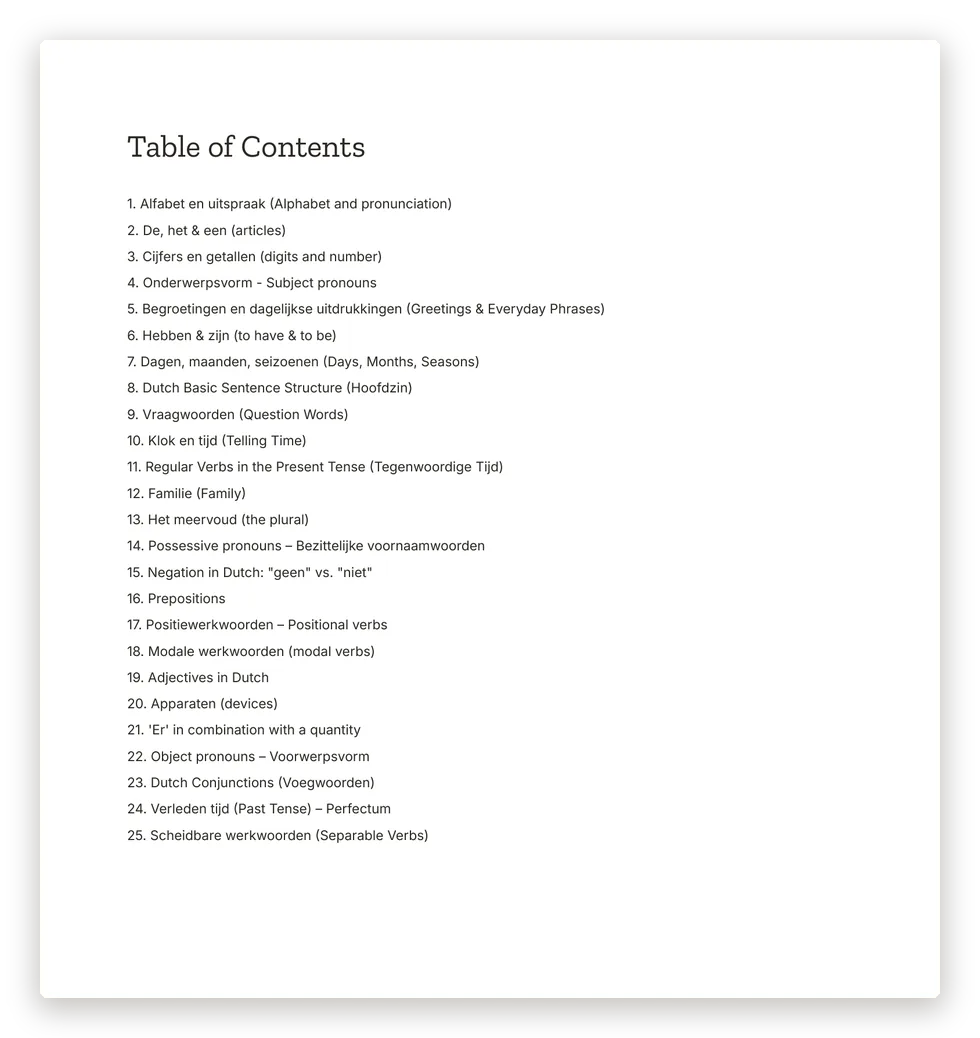
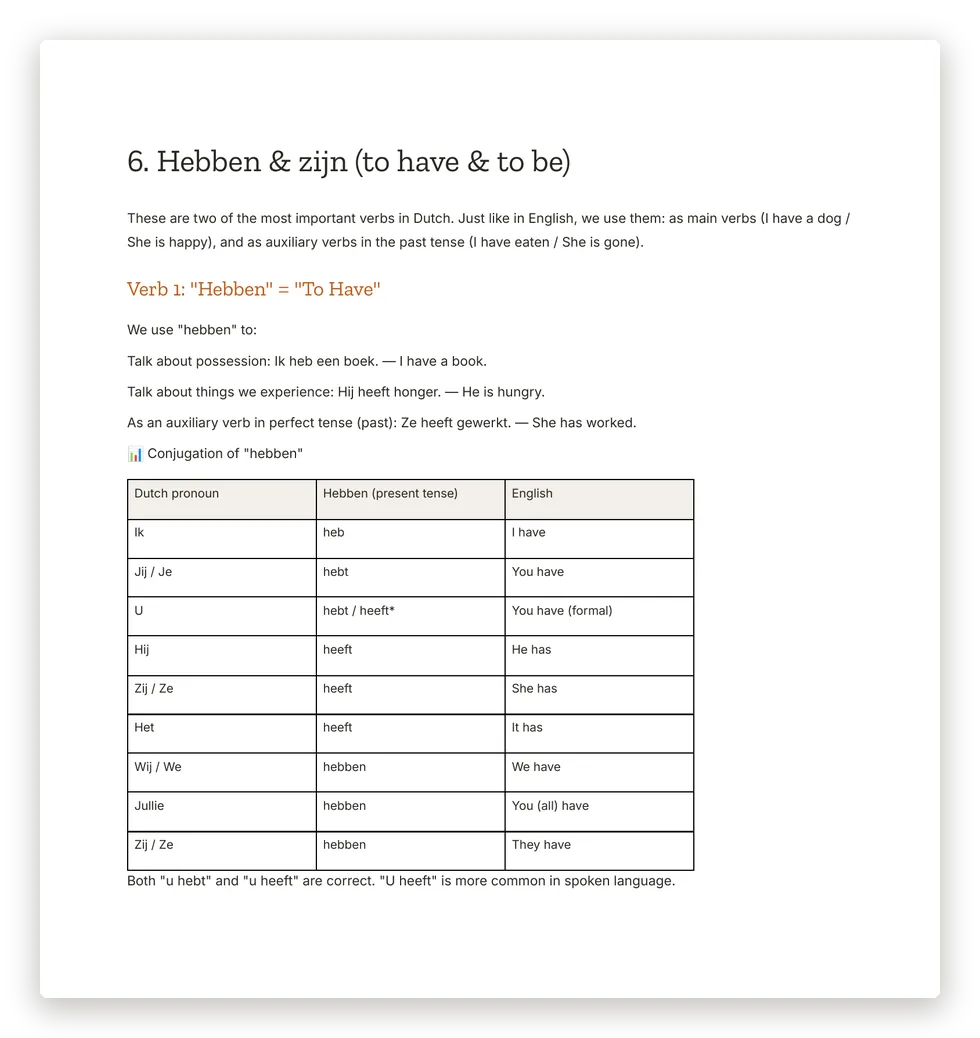
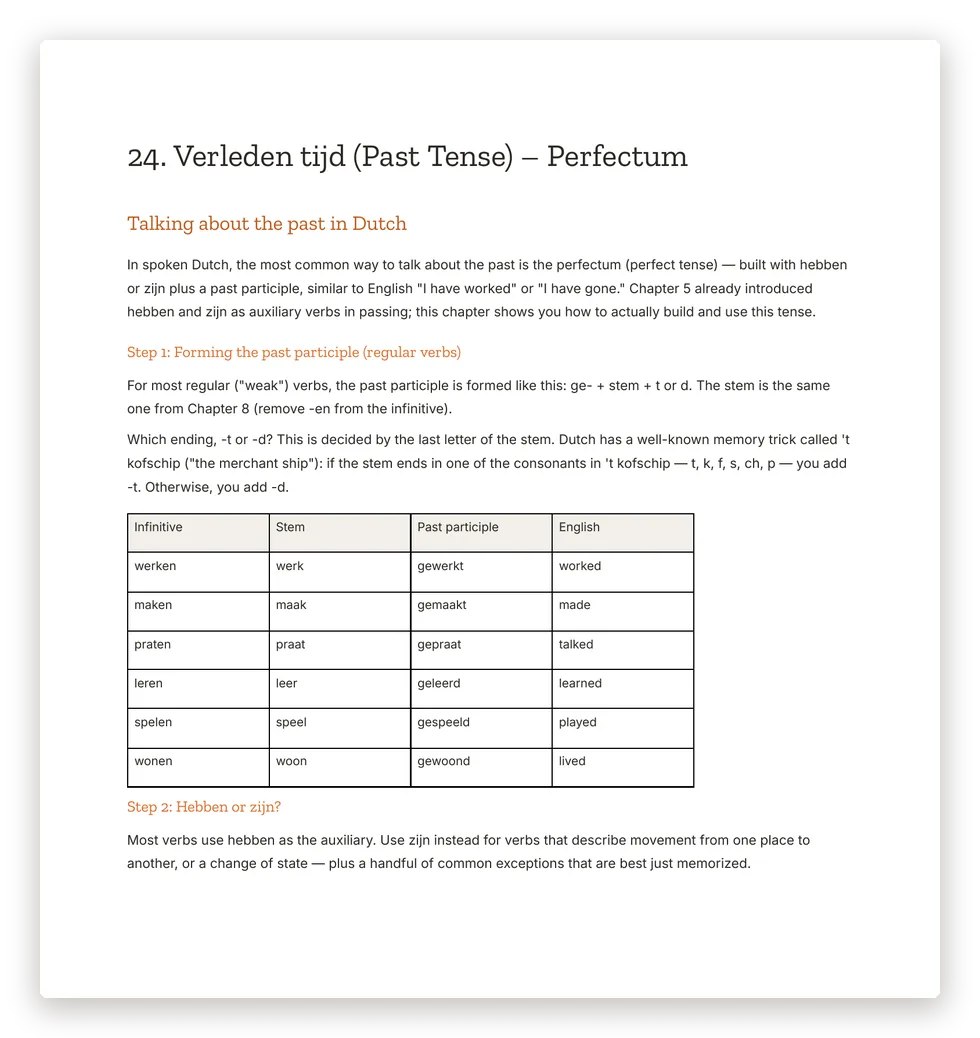
Shown: the contents of chapters 1 to 25 (all of Dutch A1), chapter 6 and chapter 24. Click a page to see it full size.
43 chapters25 chapters, one clear path
Both courses follow the same path from zero. Dutch A1 covers the first three steps; Dutch A2 covers all five. Pick a course to see what is included, and open a step to see its chapters.
-
1The foundationsSounds, articles, numbers and your first sentences with hebben and zijn.
- 1The alphabet and pronunciationhet alfabet en de uitspraak
- 2Articles: de, het and eenlidwoorden
- 3Numberscijfers en getallen
- 4Subject pronounsonderwerpsvorm
- 5Greetings and everyday phrasesbegroetingen
- 6To have and to behebben en zijn
- 7Days, months and seasonsdagen, maanden, seizoenen
-
2Everyday sentencesWord order, questions, the present tense and talking about your family.
- 8Basic sentence structurede hoofdzin
- 9Question wordsvraagwoorden
- 10Telling the timeklok en tijd
- 11Regular verbs in the present tensetegenwoordige tijd
- 12Familyfamilie
- 13The pluralhet meervoud
- 14Possessive pronounsbezittelijke voornaamwoorden
- 15Negation: geen or nietontkenning
-
3Saying morePrepositions, modal verbs, adjectives, linking sentences and your first past tense.
- 16Prepositionsvoorzetsels
- 17Sitting, standing and lyingpositiewerkwoorden
- 18Modal verbsmodale werkwoorden
- 19Adjectivesbijvoeglijke naamwoorden
- 20Devicesapparaten
- 21Er with a quantityer + hoeveelheid
- 22Object pronounsvoorwerpsvorm
- 23Conjunctionsvoegwoorden
- 24Talking about the past: the perfectumverleden tijd
- 25Separable verbsscheidbare werkwoorden
-
4Everyday vocabularyThe words you need for food, clothes, work, the body, feelings and the weather.
- 26Colourskleuren
- 27Using gaan and graaggaan en graag
- 28Food and drinketen en drinken
- 29Clothingkleding
- 30Professionsberoepen
- 31Animalsdieren
- 32The bodyhet lichaam
- 33Emotionsemoties
- 34The weatherhet weer
-
5Grammar for A2The simple past, the present perfect, comparisons and the future tense.
- 35The simple past: regular verbsonvoltooid verleden tijd
- 36The simple past: irregular verbsonregelmatige werkwoorden
- 37The present perfectvoltooid tegenwoordige tijd
- 38Irregular verbs in the present perfectonregelmatige voltooide deelwoorden
- 39Er with a prepositioner + voorzetsel
- 40Comparatives and superlativesvergrotende en overtreffende trap
- 41The future tensetoekomende tijd
- 42Demonstratives: deze, die, dit, dataanwijzende voornaamwoorden
- 43Reflexive verbswederkerende werkwoorden
Who These Courses Are For
- ✓Complete beginners who don't speak any Dutch yet, and people who only know a few words.
- ✓Expats, partners, and international employees living or working in the Netherlands.
- ✓People preparing for the first language steps toward inburgering.
- ✓Anyone who'd rather learn at their own pace than sit through a fixed class schedule.
What's Included
- ✓43 chapters in total — A1 covers the first 25 (zero to A1), A2 is the complete set (zero to A2).
- ✓Plain English throughout, no Dutch-only grammar terms to decode before you can start learning.
- ✓Linked online practice exercises after most chapters, so what you read gets used right away.
- ✓Self-paced, lifetime access as a PDF — your own schedule, and a reference to come back to.
Which Level Should You Start With?
A1 · BeginnerDutch A1New to Dutch, or only know a few words? Start here.✓25 chapters, zero to A1✓Alphabet, articles, present tense✓Everyday vocabulary✓€9.99, lifetime access€9.99See Dutch A1
A2 · Complete CourseDutch A2Want the complete course in one purchase? No need to buy A1 first.✓43 chapters, zero to A2✓Everything in A1, plus more✓Real conversations & admin Dutch✓€14.99, lifetime access€14.99See Dutch A2
Both courses are self-paced, one-time payment, with a 14-day money-back guarantee. A2 already includes everything in A1, so there's never a need to buy both.
Common Questions
Can I really learn Dutch online, on my own?
Yes. Both courses are built entirely for self-study — no classroom, no live teacher, no fixed schedule. Each chapter explains a rule in plain English, shows real Dutch examples, and most chapters link to an online practice exercise.
Which Dutch course should I choose?
If you don't speak any Dutch yet and want to try it out, start with Dutch A1. If you know you want to reach A2 — for work, daily life, or the first language steps toward inburgering — A2 is the complete course and already includes everything in A1, so it's the better value if you're committed.
What Dutch learning materials are included?
Each course is a self-paced PDF e-book: short English explanations, real Dutch example sentences, and linked online practice exercises after most chapters. There are no video lessons or live sessions — it's designed to be read and practiced at your own pace.
Is there a free way to try before buying?
Yes — six grammar topics from the courses are available as free interactive exercises on the exercises page, including de/het, hebben and zijn.
Do these courses prepare me for the inburgeringsexamen?
A2 builds the foundational grammar and vocabulary the civic integration exam's language parts expect, though it isn't a dedicated exam-prep course on its own. For exam-specific practice, see our free inburgeringsexamen pages.
What if a course isn't right for me?
Every course comes with a 14-day money-back guarantee, no questions asked.
Pick Your Starting Point
Both courses are self-paced, one-time payment, with a 14-day money-back guarantee. Pick one — A2 already includes everything in A1, so there's never a need to buy both.